Healing from Attachment Trauma: How Early Wounds Shape Our Adult Relationships and How Therapy Can Help
- catherine lee
- Jun 4, 2025
- 3 min read



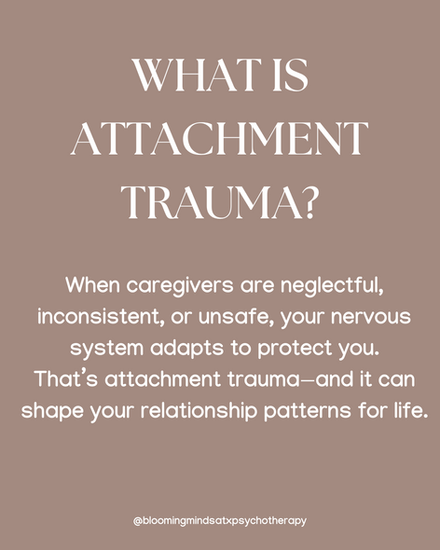





Attachment is the emotional bond we form with our earliest caregivers. When this bond is secure, we grow up feeling safe, seen, and supported. But for many, early relationships were marked by inconsistency, neglect, or harm—leading to what's known as attachment trauma. This early relational trauma can leave a lasting imprint on how we relate to others, manage stress, and feel about ourselves.
What Is Attachment Trauma?
Attachment trauma occurs when a child’s need for safety, connection, and emotional attunement is consistently unmet. This can result from overt abuse, but also from more subtle experiences—such as a parent who is emotionally unavailable, depressed, or inconsistently responsive.
Over time, these repeated ruptures in connection shape the nervous system and lead to insecure attachment styles—patterns of relating that feel safer to the child at the time, but can become problematic in adulthood.
Attachment Styles and Their Roots in Trauma
Psychologist Mary Ainsworth identified four primary attachment styles:
Secure Attachment – Develops when caregivers are consistently responsive and nurturing.
Anxious Attachment – Arises from inconsistent caregiving; the child becomes hypervigilant to cues of rejection.
Avoidant Attachment – Develops when caregivers are emotionally distant; the child learns to suppress needs.
Disorganized Attachment – Often rooted in trauma or abuse; the caregiver is both a source of comfort and fear.
Studies show that early trauma—especially when chronic or complex—can significantly increase the likelihood of developing disorganized or insecure attachment styles (Lyons-Ruth & Jacobvitz, 2016; van der Kolk, 2014). These patterns often persist into adulthood, influencing romantic relationships, friendships, and even professional dynamics.
The Neurobiology of Attachment and Safety
Attachment isn’t just emotional—it’s biological. Our nervous systems are wired to seek connection as a form of safety. According to Polyvagal Theory (Porges, 2011), safe and attuned relationships activate the ventral vagal state, associated with calm, connection, and regulation. In contrast, unsafe or neglectful relationships activate defensive states like fight/flight (sympathetic arousal) or shutdown (dorsal vagal).
Chronic attachment trauma keeps the nervous system in a state of dysregulation. This is why individuals with insecure attachment often struggle with anxiety, emotional reactivity, trust, and self-worth.
How Therapy Helps: Creating a Safe, Secure Base
Healing from attachment trauma starts with a new relational experience: one that is consistent, attuned, and safe. In therapy, this is often referred to as creating a "secure base"—a term first used by Bowlby (1988) to describe the foundation of safe attachment.
Here’s how this healing process unfolds:
1. Establishing Safety Through Co-Regulation
The therapist's attuned, nonjudgmental presence helps the client begin to feel safe enough to stay present with difficult emotions. This is known as co-regulation—the process of two nervous systems influencing each other toward regulation.
“The first step in restoring connection to self and others is learning to feel safe in relationship again.” — Bessel van der Kolk, The Body Keeps the Score (2014)
2. Recognizing and Reframing Old Patterns
Clients begin to identify how early attachment wounds show up in current relationships. With psychoeducation and compassion, they can reframe these patterns not as character flaws but as adaptations to past environments.
3. Building New Relational Templates
Over time, the therapeutic relationship itself becomes a reparative experience—one where clients feel seen, accepted, and emotionally held. This can gradually shift attachment style toward greater security (Slade, 2008).
4. Developing Self-Regulation Skills
As clients experience co-regulation, they also learn self-regulation—tools like mindfulness, grounding, and nervous system tracking that help them manage emotions without shutting down or becoming overwhelmed.
Final Thoughts
Attachment trauma can feel deeply embedded—but it’s not a life sentence. The brain and nervous system are changeable. With a safe, attuned relationship—whether with a therapist, partner, or trusted friend—healing is possible.
You deserve relationships where you feel secure, valued, and understood. Therapy can be the first step toward that kind of connection.
References:
Bowlby, J. (1988). A Secure Base: Parent-Child Attachment and Healthy Human Development. Basic Books.
Lyons-Ruth, K., & Jacobvitz, D. (2016). Attachment disorganization from infancy to adulthood: Neurobiological correlates, parenting contexts, and pathways to disorder. Development and Psychopathology, 28(2), 435–444.
Porges, S. W. (2011). The Polyvagal Theory: Neurophysiological Foundations of Emotions, Attachment, Communication, and Self-regulation. Norton.
Slade, A. (2008). The implications of attachment theory and research for adult psychotherapy: Research and clinical perspectives. In J. Cassidy & P. R. Shaver (Eds.), Handbook of Attachment (2nd ed., pp. 762–782).
van der Kolk, B. (2014). The Body Keeps the Score: Brain, Mind, and Body in the Healing of Trauma. Viking.



Comments